Showing posts with label Mangrove Species. Show all posts

Dispersal and establishment of propagules of Mangrove species


Most mangrove species have buoyant, water-borne propagules.
The dispersal of these propagules is constrained by land masses blocking current flow, and by wide bodies of water.
Such limitations on dispersal usually confines species to particular regions, depending on their dispersive range and their ability to become established in new locations. 
In order to establish new colonies and to extend existing distributional ranges, species would need to across or around either larger bodies of water or land.
The effective range of each species depends on a number of factors including:
      The number of days propagules remain bouyant and viable
      The rate of surface currents
      The water conditions and
      The availability of suitable habitats.
Flotation times of mangrove propagules, fruits and seeds vary from a few days to many months (e.g. Steinke, 1975, 1986; Rabinowitz, 1978).
Flotation time may also increase with decreased water temperature (Steinke & Naidoo, 1991) and decreased water salinity (e.g. Rabinowitz, 1978).

Characteristics of Florida mangrove tree

There are mainly three types of mangrove species in Florida mangrove of america. Characteristics of Florida mangrove trees are given below.

Red mangrove species (Rhizophora mangle)


Red mangrove species
(Rhizophora mangle)


Grows in flooded areas.
Having aerial roots, which originate downward from the trunk and lower branches.
Leaves are thick, shiny, leathery and dark green.
Fruits are long pencil shaped for viviparous germination.


Black mangrove (Avicennia germinans)
Black mangrove species
(Avecennia germinans)


Small to medium height tree can reach about 50 feet long.
Grows in the wet soils of coastal high-tide shores.
Leaves are oppositely arranged, simple and persistent.
Egg shaped capsule like green fruit having one seed.
Pencil like pneumatophores.


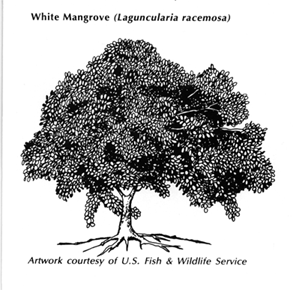
White mangrove (Laguncularia racemosa)


Usually grows on higher land.
Does not have any pneumatophores. 
Leaves are thicker, elliptical, light yellow green having two distinguishing glands at the base of the leaf blade near to stem.

Identify characteristics of mangrove species

Sunderban is the largest Mangrove forest of the earth. It is different from its beauty, site characteristics and species diversity. This forest covers 10,000 sq. km. of which about 6,000 are in Bangladesh. It became inscribed as a UNESCO world heritage site in 1997. The Sunderbans is estimated to be about 4,110 km², of which about 1,700 km² is occupied by waterbodies in the forms of river, canals and creeks of width varying from a few meters to several kilometers.

How can we identify Sunderban as a mangrove forest?
·         This area is a sheltered region for vegetation growth.
·         Tidal inundation is occurred frequently.
·         Species are halophytic because here water and soil are very much saline.

Identify characteristics of mangrove species:
Local Name
Scientific Name
Special Character
Sundri
Heritiera fomes
Grey longitudinally cracked bark, Shade bearer, climax species, leaves are shortly petiolate and grouped towards the ends of the branches & dark green
Gewa
Excoecaria agallocha
Grey, smooth and coverd with prominent lenticels; exudes a very acrid poisonous juice; simple, alternate, obovate to elliptic dark glossy green leaves.
Goran
Ceriops decandra
At the ends of the twigs, ovate to ovate oblong, entire glabrous leathery obtuse and darker green above than below.
Keora
Soneratia apetala
Pioneer strong light demander tallest species of Sunderban, stand deteriorates very quickly after maturity.
Poshur
Xylocarpus mekongensis
Medium-sized, evergreen or briefly deciduous, glabrous tree reaching of 10-20 m in height, with a trunk diameter up to 1 m in diameter with very short or even no buttresses and an elaborated above ground root system. USES The bark of the bole is rich in tannin.
Golpata
Nypa fruticans
Trunk less palm with tall erect fronds and an underground short horizontal stem; grows on the bank of the rivers.
Baen
Avicennia alba
Scattered isolated trees; pneumetaphores are thin finger like and covered with numerous lenticels; when over mature, Baen is usually hollow and rotten.
Amur
Amoora cucullata

There are 64 plant species in Sundarbans and they have the capacity to withstand estuarine conditions and saline inundation on account of tidal effects. Some species is also found by us in Sunderban such as Hantle, Sinra etc.
Sundri (Heritiera fomes)